
In the last decade, cybersecurity has shifted from being a niche concern of IT departments to a basic condition for living a normal digital life. Families, freelancers, small businesses, and students are now exposed to the same categories of threats as multinational corporations. In this context, the slogan “Cybersecurity for Everyone” is not just a marketing phrase; it reflects a profound shift in responsibility. Malwarebytes positions itself at the center of this shift, trying to bridge the gap between complex security technologies and ordinary, non‑technical users.
From Traditional Antivirus to Modern Threat Protection
Traditional antivirus tools were built around a relatively simple model: detect known viruses using signatures and block them. That worked in an era when most threats were relatively static, and malware families evolved slowly. Today’s threat landscape is fundamentally different. Attackers use polymorphic malware, fileless attacks, ransomware‑as‑a‑service, and social engineering that exploits human psychology rather than just software vulnerabilities.
Malwarebytes tries to respond to this new reality by focusing less on classic “virus hunting” and more on behavior and intent. Instead of relying solely on static signatures, its engine observes what programs do: which files they touch, which system calls they make, how they interact with the network and the browser. This behavioral approach allows Malwarebytes to detect suspicious activity even when the specific malware sample has never been seen before. In practice, this means that a zero‑day ransomware strain or a freshly packed spyware variant can still be stopped because its behavior looks dangerous, even if its exact code is new.
This move away from purely signature‑based detection is central to the idea of cybersecurity for everyone. Most users will never understand what a process injection is or how a browser exploit works. What they need is a tool that recognizes hostile behavior and intervenes on their behalf, ideally before any visible damage is done.
All‑in‑One Security Without the Complexity
Another key element of Malwarebytes’ strategy is consolidation. Security used to be a puzzle of separate tools: one program for antivirus, another for anti‑spyware, a third for ad blocking, and maybe a fourth for VPN. For technical users this might be acceptable, but for the majority it leads to confusion and weak points—out‑of‑date tools, overlapping features, and misconfigurations.
Malwarebytes tries to simplify this ecosystem by bundling multiple layers of protection under one umbrella: anti‑malware, antivirus, web protection, scam and phishing detection, and in higher‑tier plans, a VPN for secure and private browsing. The idea is not necessarily to replace every possible security tool, but to provide a strong, coherent baseline that most people can actually manage.
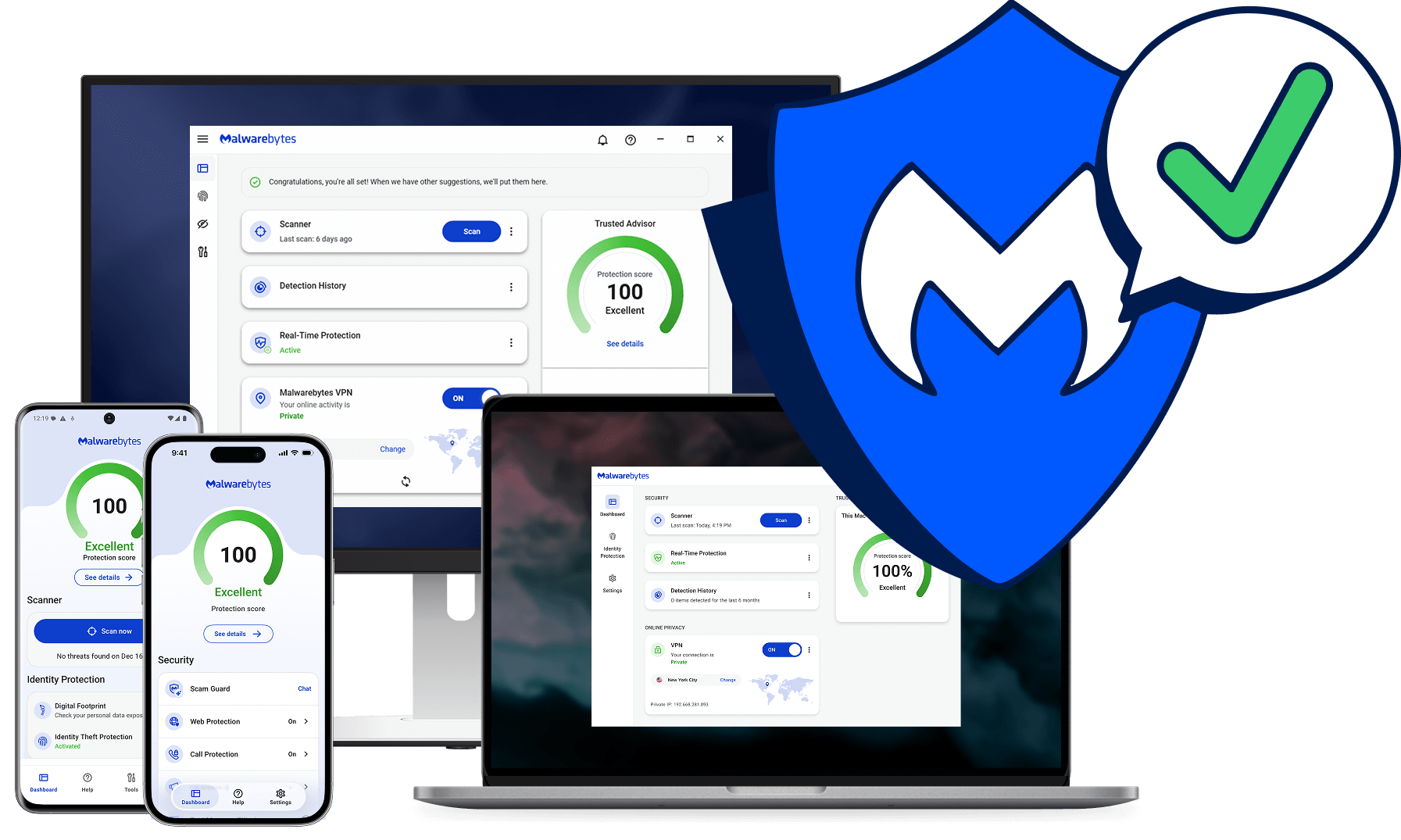
This simplicity is visible in the design of the interface. Instead of a maze of tabs and expert‑only options, Malwarebytes presents a clean dashboard with clear states—protected, at risk, or scanning. Actions map to understandable goals: scan now, quarantine threats, turn real‑time protection on or off. For many users, this is the difference between having security software installed and having it truly configured and functioning.
Free vs. Premium: Lowering the Barrier to Entry
One of the most important practical questions around “cybersecurity for everyone” is affordability. Many people only think about protection when a crisis already happened—when the computer is slow, pop‑ups appear, or files are encrypted. At that moment, the ability to download a free tool that can at least diagnose and clean an infected machine from the official Malwarebytes website becomes critical.
Malwarebytes uses a freemium model to address this. The free version focuses on on‑demand scanning and removal. It does not promise to protect you in real time, but it gives you a powerful disinfecting tool at zero cost. For users who have never paid for security software or who live in regions where pricing of Western products is high relative to local income, this free tier is often the only realistic entry point into modern malware protection.
The premium editions then extend this foundation with continuous, real‑time defense, web blocking, and VPN features. From a business perspective, this is a classic upsell path. From a societal perspective, it is also a way of ensuring that even people who never convert to paying customers still have access to a serious malware removal engine. That dual logic—commercial sustainability combined with a kind of minimum safety net—is part of what makes “for everyone” more than just a slogan.
Cross‑Platform and the Reality of Multi‑Device Lives
Cybersecurity used to be synonymous with “protect your PC.” That is no longer true. Today, an average person might own a Windows laptop, an Android phone, an iPad, and perhaps a work MacBook. Attackers understand this and increasingly target the weakest link, which is often the smartphone: a device full of banking apps, authentication codes, private chats, and personal photos.
Malwarebytes reflects this reality by offering tools not only for Windows and macOS, but also for Android and iOS. On mobile platforms, the focus shifts somewhat—from classic file‑based malware to browser‑based phishing, malicious apps, rogue configuration profiles, and intrusive trackers. Web protection and scam blocking become just as important as traditional virus detection.
The multi‑device nature of modern life also makes licensing models relevant. When one subscription can protect several devices regardless of platform, families and small businesses are much more likely to maintain consistent protection across their entire digital environment. Without this, security often ends up fragmented: one protected laptop, one half‑protected phone, and a forgotten, vulnerable tablet.
Education as a Security Feature
A less visible but strategically important part of Malwarebytes’ “for everyone” promise is its educational work. Technical defenses can stop many attacks, but human behavior remains one of the weakest points in cybersecurity. People reuse passwords, click on suspicious links, download attachments from unknown senders, and fall for social engineering.
By publishing guides, blogs, and “cybersecurity basics” resources in accessible language, Malwarebytes tries to reduce this human vulnerability. Many of these resources are available directly on the Malwarebytes website. Articles that explain what phishing looks like, how scammers imitate delivery companies or banks, or why public Wi‑Fi without encryption is risky can change user behavior even beyond the Malwarebytes product ecosystem.
In this sense, education itself becomes a form of security product—one that scales globally and does not require installation. If millions of users learn to recognize the signs of a scam from these materials, a significant number of attacks will fail before any malware needs to be detected at the technical level.
Limitations and the Role in a Larger Security Strategy
It is important to recognize that Malwarebytes, despite its strengths, is not a magic shield. Independent tests and user reviews often highlight excellent malware and potentially unwanted application detection, but they also note areas where the product is intentionally lean. For example, Malwarebytes historically has not tried to be an all‑inclusive “mega‑suite” with every possible feature, and it may rely on the operating system’s own firewall rather than shipping a heavy, proprietary one.
For advanced users and organizations, Malwarebytes is often used as part of a layered defense strategy rather than as the only line of defense. It might coexist with built‑in protections such as Windows Defender, with network‑level controls like DNS filtering, or with backup systems that mitigate the impact of ransomware. In that layered view, Malwarebytes’ role is clear: act as a strong, user‑friendly shield against the most common and dangerous threats, without overwhelming users with complexity.
Cybersecurity for Everyone: Ideal, Not Slogan
Ultimately, the phrase “Cybersecurity for Everyone” describes an ideal state where protection is not a privilege reserved for experts, rich countries, or corporate networks. Malwarebytes contributes to this ideal in several practical ways: by offering powerful free cleanup tools, by simplifying the user experience, by supporting multiple platforms and devices, and by investing in educational content that empowers users instead of merely scaring them.
The deeper idea behind the product is that if security is too complex, too expensive, or too confusing, people will quietly stop using it—or will never adopt it in the first place. By focusing on clarity, behavioral detection, and accessible pricing, Malwarebytes attempts to push the industry toward a more inclusive model of protection. In a world where a single careless click can compromise a person’s finances, identity, or business, that inclusivity is not just a competitive advantage; it is a social necessity.
In this sense, Malwarebytes is more than just an anti‑malware tool. It is part of a broader movement to make high‑quality cybersecurity a normal, expected feature of digital life, rather than a specialized luxury. Whether that vision is fully realized will depend not only on Malwarebytes itself, but on how seriously users, companies, and governments treat the promise of security for everyone.